
If you’re going through common interview questions and answers for freshers to prepare for your first job interview, you’re doing exactly the right thing. Most fresher interviews, across industries and roles, tend to circle back to a similar core set of questions — and walking in with thoughtful, well-practiced answers can make the difference between sounding nervous and sounding genuinely ready.
This guide covers the questions freshers are asked most often, explains what interviewers are actually trying to learn from each one, and gives you sample answers you can adapt to your own background. By the end, you’ll have a clear framework for handling almost any question that comes your way, even ones not listed here directly.
Table of Contents
Why Freshers Get Asked the Same Questions
Since freshers don’t have a work history to discuss in depth, interviewers rely on a fairly standard set of questions to evaluate the things that matter most at entry level: communication skills, self-awareness, motivation, and basic problem-solving ability. These questions aren’t designed to trick you — they’re designed to get a clear read on how you think and communicate, since that’s often a better predictor of fresher success than technical knowledge alone.
Understanding this shifts how you should prepare. Instead of trying to memorize a “perfect” answer, focus on genuinely understanding what each question is trying to uncover, so your response feels natural even if the exact wording of the question changes slightly in the actual interview.
How to Structure Your Answers
Before getting into specific questions, it helps to have a general framework for structuring your responses:
- Keep it concise. Most fresher interview answers should be 30–60 seconds long, unless the interviewer specifically asks for more detail.
- Use a specific example where possible. Instead of saying “I’m a good team player,” describe a specific college project or activity that demonstrates it.
- Connect it back to the role. Where relevant, tie your answer to something specific about the job or company you’re interviewing for.
- End with confidence, not a trailing off. Finish your answer clearly rather than fading out uncertainly.
Keep this structure in mind as you go through the questions below.
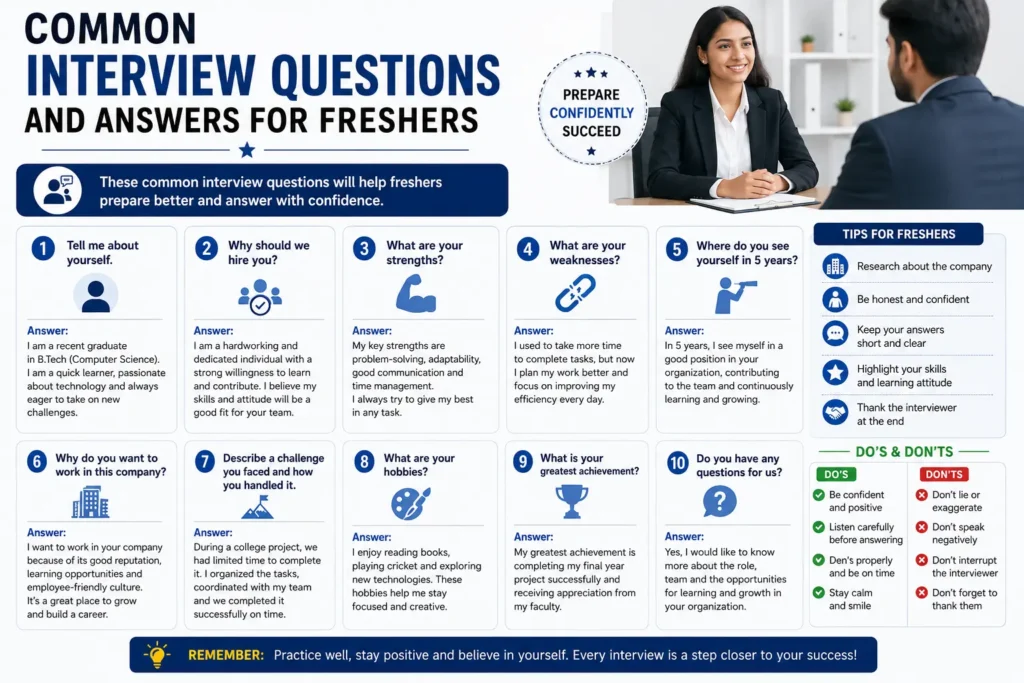
Common Interview Questions and Answers for Freshers
1. “Tell me about yourself.”
This is almost always the opening question. Interviewers want a brief, organized summary of your background, not your entire life story.
Sample Answer: “I recently completed my [Degree] from [College Name]. During my final year, I worked on a project involving [brief description], which strengthened my [relevant skill]. I’m now looking to start my career in a [role type] position, and I’m excited about this opportunity because [specific reason].”
2. “Why do you want to work here?”
This question tests whether you’ve actually researched the company, or if you’re applying to every listing you can find.
Sample Answer: “I’ve been following [Company Name]’s work in [specific area], and I’m particularly drawn to [specific project, value, or growth path]. I believe this role would let me apply my [relevant skill] while learning from a team working on [specific area].”
3. “What are your strengths?”
Interviewers want to know if you’re self-aware and can back up your claims with real examples.
Sample Answer: “One of my key strengths is problem-solving. During my final year project, I ran into [a specific challenge] and worked through it by [brief explanation of your approach], which ultimately helped the team meet our deadline.”
4. “What are your weaknesses?”
This question isn’t about listing flaws — it’s about showing self-awareness and a genuine effort to improve.
Sample Answer: “I used to find public speaking challenging, so I started taking on presentation opportunities during college projects specifically to work on it. I’ve improved a lot, though it’s still something I continue to actively work on.”
5. “Where do you see yourself in five years?”
Interviewers use this to gauge whether your goals align reasonably well with the role and company, not to hold you to an exact plan.
Sample Answer: “In five years, I’d like to have grown into a role where I’ve built strong expertise in [relevant field] and can take on more responsibility, ideally within a company where I can keep learning and contributing meaningfully.”
6. “Why should we hire you?”
This is your chance to directly connect your background to what the company needs.
Sample Answer: “I bring a strong foundation in [relevant skill] built through my academic projects and coursework, along with a genuine eagerness to learn quickly on the job. I believe I can contribute right away while continuing to grow into the role.”
7. “Describe a challenge you faced and how you handled it.”
This is a behavioral question aimed at understanding your problem-solving approach in a real situation.
Sample Answer: “During a group project, we were behind schedule with two weeks left before submission. I suggested we break the remaining work into smaller daily tasks and check in briefly each day, which helped us get back on track and submit on time.”
8. “What do you know about our company?”
This tests basic preparation. A vague or incorrect answer here can hurt your credibility more than almost any other question.
Sample Answer: “[Company Name] works primarily in [industry/sector], and I understand you’ve recently been focused on [specific recent project, product, or expansion]. That’s part of what drew me to apply for this role.”
9. “How do you handle pressure or tight deadlines?”
Interviewers want reassurance that you won’t fall apart under normal workplace pressure.
Sample Answer: “I handle pressure by breaking tasks down into smaller, manageable steps and prioritizing what needs to be done first. During my internship, I had to complete [specific task] within a tight timeline, and this approach helped me stay organized and meet the deadline.”
10. “Do you have any questions for us?”
This question comes at the end, and answering “no” is one of the most common missed opportunities for freshers. Always have at least one or two thoughtful questions prepared (see the dedicated section below).
Behavioral Questions for Freshers
Behavioral questions ask you to describe a real situation from your past, usually starting with phrases like “Tell me about a time when…” or “Describe a situation where…”. These are best answered using the STAR method:
- Situation — briefly set the context
- Task — explain what needed to be done
- Action — describe what you specifically did
- Result — share the outcome, ideally with a specific detail
Example Question: “Tell me about a time you worked in a team to achieve a goal.”
Sample STAR Answer: “During my final semester, our group was assigned a project with a tight deadline (Situation). My task was to coordinate the data collection portion of the project (Task). I created a shared tracking sheet and set daily mini-deadlines to keep everyone aligned (Action). As a result, we submitted the project two days early and received positive feedback from our professor (Result).”
This structure works for almost any behavioral question, whether it’s about teamwork, conflict, leadership, or handling failure.
Questions About Weaknesses and Gaps
Freshers often worry about questions related to gaps in their resume, average academic scores, or lack of internship experience. Here’s how to approach these honestly without undermining your candidacy:
If asked about a lower academic percentage: “My academic scores don’t fully reflect my interest in the field — I was also actively involved in [relevant project/activity], which is where I built most of my practical understanding.”
If asked about no internship experience: “While I didn’t have a formal internship, I worked on [specific personal or academic project] that gave me hands-on exposure to [relevant skill], which I believe translates well to this role.”
If asked about a gap year or delay in graduation: Be honest and brief. A simple, factual explanation (“I took time to [reason], and used that period to [something constructive, if applicable]”) is far more effective than over-explaining or sounding defensive.
Questions to Ask the Interviewer
Ending an interview with no questions can make you seem disengaged. A few strong options for freshers include:
- “What does a typical first few months in this role look like?”
- “What qualities have made someone successful in this position before?”
- “Are there opportunities for learning or upskilling within the team?”
- “What are the biggest priorities for this team over the next few months?”
Avoid asking about salary or leave policy in the first interview round unless the interviewer brings it up — save those for later stages or HR-specific discussions.
Common Mistakes to Avoid
- Giving one-word or overly short answers. Even simple questions deserve a complete, thoughtful response.
- Speaking negatively about your college, professors, or previous internship. This raises concerns about how you might speak about a future employer.
- Memorizing answers word-for-word. This often comes across as rehearsed rather than genuine — know your key points, not a script.
- Not having a “why this company” answer. A generic answer here signals a lack of real interest.
- Avoiding the weakness question entirely. Claiming to have no weaknesses seems evasive rather than confident.
- Forgetting to ask any questions at the end. This is a small detail that leaves a surprisingly strong impression when done well.
Expert Tips for Interview Day
- Research the company beyond the homepage. Check recent news, LinkedIn updates, or their “About” page for specific details you can reference naturally.
- Prepare 5–6 core stories from your academic or project experience that can be adapted to answer multiple behavioral questions.
- Practice out loud, not just mentally, ideally with a friend or in front of a mirror, so your delivery sounds natural rather than read from memory.
- Bring physical copies of your resume and any certificates, even if you’ve already submitted them online.
- Arrive early, but not too early — 10 to 15 minutes before your scheduled time is ideal for both punctuality and calm preparation.
Frequently Asked Questions
1. What is the most common first question in a fresher interview? “Tell me about yourself” is by far the most common opening question, used to get a quick, organized overview of your background.
2. How should freshers answer “What are your weaknesses?” By naming a real but manageable weakness and briefly explaining the steps you’ve taken to improve on it, rather than giving a vague or overly rehearsed answer.
3. What is the STAR method? STAR stands for Situation, Task, Action, and Result — a structured way to answer behavioral interview questions using a real example from your past experience.
4. Should freshers ask questions at the end of an interview? Yes. Asking one or two thoughtful questions shows genuine interest and engagement, and not asking any can come across as disinterest.
5. How long should interview answers be for freshers? Most answers should be around 30 to 60 seconds, unless the interviewer specifically asks for more detail on a particular point.
6. What if I don’t have any internship experience to talk about? Focus on academic projects, coursework, or extracurricular activities that demonstrate relevant skills — these are valid substitutes for freshers without internship experience.
7. How do I answer if I have a lower academic percentage? Acknowledge it briefly and honestly, then pivot to relevant projects, skills, or activities that better reflect your capabilities and interest in the field.
8. Is it okay to say I don’t know the answer to a technical question? Yes, it’s better to honestly admit you’re unsure rather than guessing incorrectly, and you can add that you’re eager to learn more about that specific area.
9. What should I avoid saying about my previous college or internship? Avoid speaking negatively, even if your experience wasn’t ideal. Focus on what you learned rather than what went wrong.
10. How can I reduce nervousness before an interview? Practicing your key answers out loud multiple times, preparing in advance, and focusing on steady breathing just before the interview can significantly help manage nervousness.
Conclusion
Interviews can feel unpredictable, but for freshers, most questions circle back to a fairly consistent set of themes: who you are, why you want the role, and how you think through challenges. Preparing thoughtful, honest, and structured answers — rather than memorized scripts — will help you sound confident and genuine on interview day.
Practice these questions a few times in your own words, and you’ll walk into your next interview far more prepared than most candidates. Ready to put it into action? Check out the latest fresher job openings and walk-in interviews on FreshersDrives.com and take the next step in your career.
Read More: