
If you’re looking for group discussion tips for freshers, chances are you have a GD round coming up as part of a campus placement, off-campus drive, or MBA/management entrance selection process. For many freshers, the group discussion round feels more intimidating than a one-on-one interview — you’re not just answering questions, you’re competing for airtime with several other candidates while being evaluated in real time.
The good news is that a GD round rewards preparation and strategy far more than raw confidence alone. This guide breaks down exactly how group discussions are evaluated, how to structure your points, common topics you might encounter, and the mistakes that quietly cost most candidates their selection.
Table of Contents
What Is a Group Discussion and Why Companies Use It
A Group Discussion (GD) is a selection round where a group of candidates, typically 8 to 15, are given a topic and asked to discuss it for a fixed period, usually 10 to 15 minutes, while evaluators observe silently. Unlike an interview, there’s no back-and-forth with an evaluator — you’re being assessed purely on how you interact with your peers.
Companies and institutes use GDs because they reveal things a one-on-one interview often can’t: how you behave in a group setting, whether you can express opinions without dominating others, how you handle disagreement, and whether you can think on your feet under mild social pressure. For roles that involve teamwork, client interaction, or leadership potential, this makes the GD round a genuinely useful filter — not just an arbitrary hurdle.
What Evaluators Are Actually Looking For
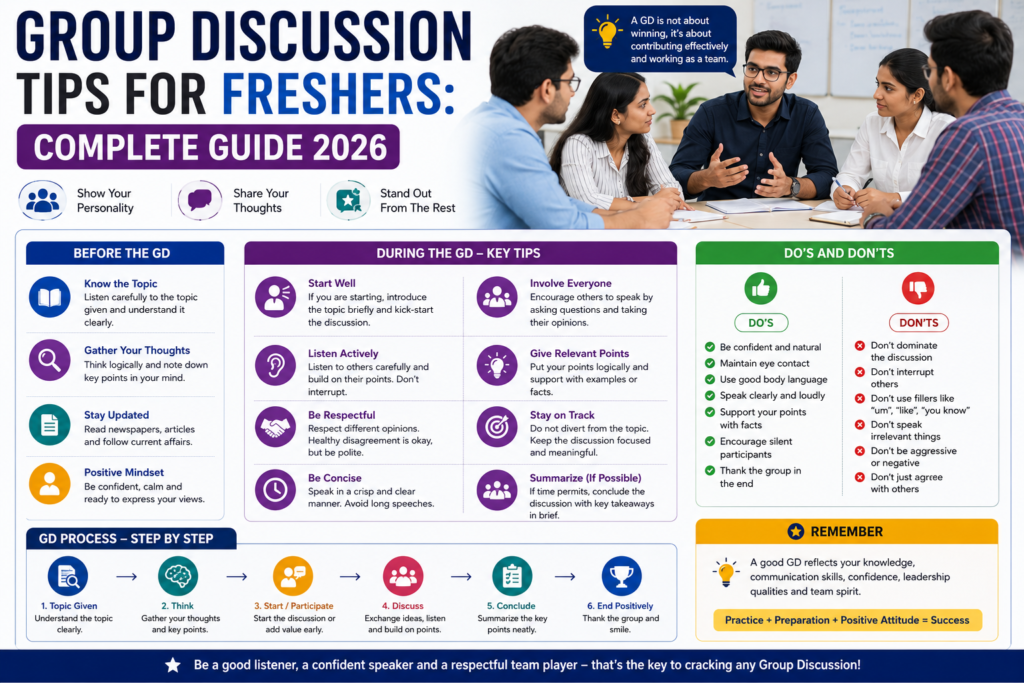
Understanding the evaluation criteria changes how you should approach the discussion. Evaluators are generally scoring candidates on:
- Content knowledge — do you have relevant, accurate points to contribute on the topic?
- Communication skills — can you express your point clearly and concisely?
- Listening skills — do you actually respond to what others say, or just wait for your turn to speak?
- Body language and confidence — are you calm and composed, or visibly nervous and hesitant?
- Leadership and initiative — do you help guide the discussion productively, especially if it stalls or goes off-topic?
- Team behavior — can you disagree respectfully without becoming aggressive or dismissive?
Notice that speaking the most isn’t on this list. In fact, dominating the conversation without letting others contribute is one of the fastest ways to get marked down, not up.
How to Prepare Before the GD Round
Stay Updated on Current Affairs
GD topics frequently draw from recent news, business trends, technology developments, and social issues. Spending 15–20 minutes a day reading a reliable news source in the weeks leading up to your GD round will give you a solid base of topics to draw from.
Practice with Mock Groups
If possible, practice with friends or classmates in a simulated GD format. This helps you get comfortable with the pace and pressure of a real discussion, and helps you notice habits (interrupting, going silent, rambling) that are hard to catch on your own.
Prepare a Mental Framework, Not Scripted Points
Rather than memorizing specific arguments for specific topics, practice building quick mental frameworks — for example, breaking any topic into “advantages, disadvantages, and a balanced conclusion” — so you can adapt to whatever topic actually comes up.
Work on Your Opening Lines
Since a strong opening often sets a positive tone (and helps you get noticed early), it helps to have a few flexible opening templates ready, such as stating the topic’s relevance, giving a quick definition, or citing a well-known fact or statistic related to it.
How to Structure Your Points During a GD
A clear structure makes your contribution easier to follow and more memorable. A simple and effective approach:
- State your point clearly and briefly. Avoid long-winded introductions before making your actual point.
- Support it with a reason or example. A point without justification sounds like an opinion; a point with a reason sounds like an argument.
- Connect back to the topic. If the discussion has drifted, briefly acknowledging that and steering back can position you as someone who adds structure to the group.
- Keep individual contributions short. Aim for 20–30 seconds per turn rather than trying to say everything at once — this also gives you more natural opportunities to speak multiple times.
How to Enter and Exit a Group Discussion Smoothly
Entering the Discussion
- Don’t force your way in by interrupting mid-sentence. Wait for a natural pause, then jump in confidently.
- If you’re struggling to find an opening, use a transition phrase like “Building on what [name/point] just said…” or “I’d like to add a different perspective here…”
- Speaking early (in the first two or three minutes) tends to help, since it gets you noticed before the group settles into its usual dynamic — but don’t rush in with a weak point just to speak first.
Exiting or Pausing Gracefully
- If the conversation moves on while you’re mid-thought, it’s fine to let it go rather than forcing your point back in awkwardly.
- If asked to summarize (some GDs end with a summary round), keep it brief, neutral, and inclusive of the different viewpoints raised, rather than only your own.
Common GD Topics for Freshers
While actual topics vary, GD topics for freshers tend to fall into a few broad categories:
Current Affairs and Business
- Impact of remote work on productivity
- Should there be a four-day work week?
- Role of artificial intelligence in the future of jobs
Social and Ethical Topics
- Is social media doing more harm than good?
- Should exams be the only measure of a student’s ability?
- Work-life balance in today’s corporate culture
Abstract or Opinion-Based Topics
- Is failure necessary for success?
- Does technology make us more or less connected?
Case Study-Based GDs
Some companies use a short business scenario instead of a direct topic, asking the group to discuss possible solutions or approaches. These require slightly more structured, practical thinking rather than opinion-based arguments.
Practicing across all four categories, rather than focusing only on one type, will prepare you for a wider range of possible topics on the actual day.
Common Mistakes to Avoid
- Trying to dominate the discussion. Speaking the most doesn’t guarantee the highest score — and can actively hurt you if it comes at the cost of others contributing.
- Staying completely silent. The opposite extreme is just as risky. Even two or three well-placed contributions are far better than none.
- Interrupting aggressively. Cutting people off repeatedly signals poor listening skills and can create a negative impression quickly.
- Going off-topic. Straying too far from the core subject, even with an interesting point, can be seen as a lack of focus.
- Being overly aggressive during disagreements. Disagreeing with a point is fine; dismissing another candidate personally or raising your voice is not.
- Repeating points already made. If your point has already been said by someone else, acknowledge it briefly and add something new rather than repeating it just to speak.
Expert Tips to Stand Out
- Take brief notes during the discussion. Jotting down key points others make helps you build on their ideas later and shows attentiveness.
- Use data or examples when you can. Even a rough statistic or a well-known example strengthens your point far more than a general opinion.
- Practice active listening body language — nodding, maintaining eye contact with whoever is speaking — since evaluators often watch this even when you’re not talking.
- If the group struggles to conclude, offer to help summarize. Volunteering to bring the discussion to a structured close is a strong, low-risk way to demonstrate initiative.
- Stay calm if you make a factual error. Correcting yourself briefly and moving on is far better than getting flustered or over-explaining.
Frequently Asked Questions
1. How long does a typical GD round last? Most group discussions last between 10 and 15 minutes, though this can vary depending on the group size and the organization conducting it.
2. Is it necessary to speak first in a GD? No, it’s not necessary, but speaking within the first two or three minutes with a solid point can help you get noticed early in the discussion.
3. What if I don’t know much about the given topic? Focus on general reasoning, logical structure, and relevant examples you do know, rather than trying to fake specific expertise you don’t have.
4. Is it bad to disagree with other candidates in a GD? No, respectful disagreement is actually seen positively, as it shows independent thinking — as long as it’s expressed calmly and without personal criticism.
5. How many times should I speak during a group discussion? There’s no fixed number, but aiming for 3 to 5 meaningful contributions throughout the discussion is generally a good balance between participation and dominance.
6. What should I do if the group discussion goes off-topic? You can politely steer it back by saying something like, “Going back to the core topic, I think…” — this is often viewed positively as a sign of structured thinking.
7. Are GD topics always related to current affairs? Not always. Topics can range from current affairs and business trends to abstract, opinion-based, or case-study-based subjects, so broad preparation is more useful than narrow topic-specific preparation.
8. What body language mistakes should freshers avoid in a GD? Avoid looking down or away while others speak, crossing your arms defensively, or appearing visibly disengaged — evaluators observe body language throughout, not just while you’re speaking.
9. Can I take notes during a group discussion? Yes, and it’s actually a good habit. Jotting down key points helps you build on others’ ideas and reference them accurately later in the discussion.
10. What’s the biggest difference between a GD and a formal debate? A debate typically involves defending one fixed side of an argument, while a GD is more collaborative — the goal is a well-rounded exchange of views, not simply winning an argument.
Conclusion
A group discussion round rewards preparation, structure, and balanced participation far more than aggressive confidence or memorized facts. By understanding what evaluators are really looking for, practicing a flexible point-structuring habit, and staying calm during disagreements, freshers can turn what feels like an intimidating round into one of their strongest opportunities to stand out.
Practice with a few mock sessions before your actual GD, and you’ll walk in with far more confidence than most candidates in the room. Ready for your next opportunity? Check out the latest fresher job openings and walk-in interviews on FreshersDrives.com and take the next step in your career.
Read More: