
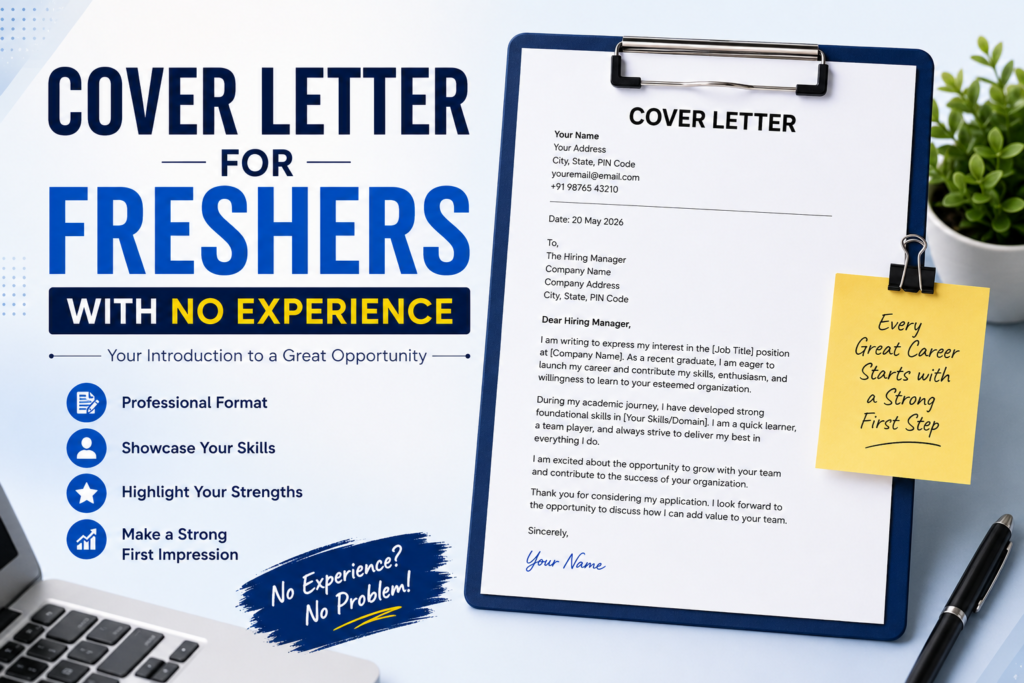
Writing a cover letter for freshers with no experience can feel like an odd exercise — how do you convince a recruiter you’re worth interviewing when you don’t have a job history to point to? The truth is, a cover letter isn’t meant to repeat your resume; it’s meant to explain, in your own voice, why you’re a good fit for this specific role, even without formal work experience behind you.
Done well, a cover letter can actually work in your favor as a fresher. It’s one of the few parts of your application where you control the narrative completely, rather than fitting your background into a resume’s rigid format. This guide walks you through exactly how to write one, with ready-to-adapt samples for different situations.
Table of Contents
Do Freshers Really Need a Cover Letter?
Not every application requires one — many online job portals and ATS-based application forms don’t ask for a cover letter at all. But when a cover letter is optional or explicitly requested, freshers who skip it are missing a real opportunity, since a well-written one can meaningfully strengthen an otherwise thin resume.
For roles where you’re applying directly via email to a company (rather than through a job portal), a short cover letter in the email body is often expected as standard practice, even if not explicitly asked for.
What a Cover Letter Should Actually Do
A cover letter’s real job is to answer three questions a resume alone often can’t:
- Why this role, specifically? Not just any job, but this one.
- Why you, despite limited experience? What makes your background, even without work history, relevant.
- What’s your genuine interest in the company? Not generic enthusiasm, but something specific.
If your cover letter doesn’t clearly answer these three questions, it’s not doing its job — regardless of how polished the writing sounds.
Structure of an Effective Fresher Cover Letter
A strong fresher cover letter typically follows this structure:
- Opening line — state the role you’re applying for and where you found it
- Paragraph 1 — briefly introduce your educational background and relevant skills
- Paragraph 2 — connect your academic projects, internships, or certifications to what the role requires
- Paragraph 3 — express genuine interest in the company and what draws you to it specifically
- Closing line — a confident call to action, inviting further conversation
Keep the entire letter to three to four short paragraphs — ideally under 300 words. Recruiters skim cover letters quickly, so brevity and clarity matter more than length.
How to Write Each Section (Step by Step)
Step 1: Start with a Clear, Direct Opening
Avoid vague openers like “I am writing to apply for a job.” Instead, be specific: mention the exact role and where you saw it listed.
Example: “I am writing to apply for the Software Developer Trainee position listed on your careers page, and I believe my academic background in Computer Science makes me a strong fit for this role.”
Step 2: Introduce Your Background Briefly
Mention your degree, college, and graduation year in one or two sentences — this is context, not the main focus.
Step 3: Highlight Relevant Projects or Skills
This is the most important section for freshers. Instead of vague claims, describe a specific project, internship, or certification, and connect it directly to what the job requires.
Example: “During my final year, I built a web application using React and Node.js as part of my capstone project, which gave me hands-on experience with the same technology stack mentioned in your job posting.”
Step 4: Show Genuine Interest in the Company
Avoid generic statements like “I want to grow my career.” Instead, mention something specific — a product, value, or recent development — that genuinely drew you to apply.
Step 5: End with a Confident Closing
Thank the reader for their time, and express interest in discussing your application further, without sounding overly eager or apologetic.
Sample Cover Letters for Freshers
Sample 1: IT/Software Fresher
Dear Hiring Manager,
I am writing to apply for the Software Developer Trainee position at [Company Name], as advertised on [platform/source]. I recently completed my B.Tech in Computer Science from [College Name], with a strong focus on web development and problem-solving.
During my final year, I built a full-stack web application using React and Node.js as part of my capstone project, which strengthened my practical understanding of the technologies mentioned in your job description. I also completed a certification in [relevant course], which deepened my knowledge of [related concept].
I’ve been following [Company Name]’s work in [specific product/area], and I’m excited about the opportunity to contribute to a team working on meaningful, real-world problems while continuing to grow as a developer.
Thank you for considering my application. I’d welcome the opportunity to discuss how my background could be a good fit for your team.
Sincerely, [Your Name]
Sample 2: Non-Technical/General Fresher
Dear Hiring Manager,
I am writing to apply for the Marketing Trainee position at [Company Name], which I came across on [platform/source]. I recently graduated with a degree in [Degree] from [College Name], where I developed a strong interest in digital marketing through coursework and hands-on college projects.
During my final year, I led a social media campaign for a college event, which grew our audience engagement significantly and gave me practical exposure to content planning and analytics. I also completed a short internship at [Organization Name], where I supported the team with [specific task].
I admire [Company Name]’s approach to [specific campaign, value, or product], and I would be excited to bring my enthusiasm and growing skill set to a team working on impactful marketing initiatives.
Thank you for your time and consideration. I look forward to the possibility of discussing this opportunity further.
Sincerely, [Your Name]
Sample 3: Short Email Cover Letter (For Direct Email Applications)
Subject: Application for [Role Name] – [Your Name]
Dear [Hiring Manager’s Name / Hiring Team],
I’m writing to apply for the [Role Name] position at [Company Name]. I recently completed my [Degree] from [College Name] and have hands-on experience with [relevant skill] through [brief mention of a project or internship].
I’ve attached my resume for your review and would welcome the opportunity to discuss how I could contribute to your team.
Thank you for your time.
Best regards, [Your Name] [Phone Number]
Cover Letter vs Resume: What’s the Difference
Freshers often wonder why a cover letter is needed at all if the resume already lists their education and skills. The key difference is tone and purpose:
| Aspect | Resume | Cover Letter |
|---|---|---|
| Format | Structured, bullet-point based | Narrative, written in full sentences |
| Purpose | Lists what you’ve done and know | Explains why it matters for this specific role |
| Tone | Factual and concise | Personal and persuasive |
| Length | 1 page | 3–4 short paragraphs |
A resume tells the recruiter what you’ve done. A cover letter tells them why it matters for their specific opening — that’s the gap it’s meant to fill.
Common Mistakes to Avoid
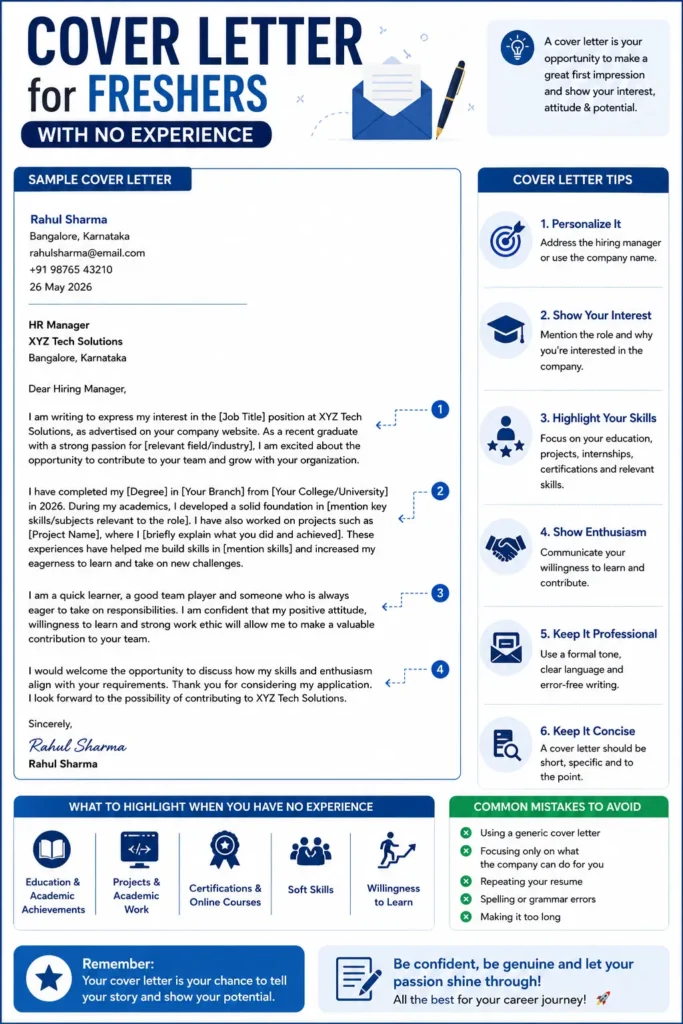
- Using the same generic letter for every application. Recruiters can usually tell when a cover letter hasn’t been customized for their specific role.
- Repeating the resume word-for-word. A cover letter should add context and narrative, not duplicate bullet points in paragraph form.
- Making it too long. A cover letter longer than half a page tends to lose the reader’s attention rather than strengthen your case.
- Focusing only on what you want, not what you offer. Statements like “This job would be great for my career” without connecting back to your value can come across as self-centered.
- Starting with “To Whomsoever It May Concern” when the hiring manager’s name is available. A quick LinkedIn or company website search can often reveal the actual name, making your letter feel more personal.
- Spelling or grammar mistakes. Since a cover letter is a writing sample by nature, even small errors here create an outsized negative impression.
Expert Tips to Make Your Cover Letter Stand Out
- Mirror language from the job description. If the posting emphasizes “attention to detail,” use similar language naturally in your letter where it applies to your own experience.
- Lead with your strongest, most relevant point. Don’t save your best example for the end — recruiters often skim, so put your strongest project or skill early.
- Keep formatting simple and clean. Avoid unusual fonts, colors, or graphics — a cover letter is judged on content and clarity, not visual design.
- Proofread out loud. Reading your letter aloud helps catch awkward phrasing that looks fine on paper but sounds unnatural when spoken.
- Save it as a PDF before sending, unless a specific format is requested, to preserve formatting across different devices and email clients.
Frequently Asked Questions
1. Do freshers really need a cover letter if they have no experience? Yes, especially when applying directly via email or when a cover letter is requested. It helps explain your fit for the role in a way a resume alone often can’t.
2. How long should a fresher’s cover letter be? Ideally three to four short paragraphs, under 300 words in total. Recruiters typically skim cover letters quickly, so brevity matters.
3. Can I use the same cover letter for multiple job applications? It’s best to customize at least the company-specific paragraph for each application, even if you reuse the overall structure, since generic letters are often easy to spot.
4. What should freshers include instead of work experience in a cover letter? Academic projects, internships, certifications, and extracurricular activities that demonstrate relevant skills work well as substitutes for formal work experience.
5. Should a cover letter repeat what’s already in the resume? No. A cover letter should add context and explain the “why” behind your resume points, not simply restate them in paragraph form.
6. Is it okay to send a short cover letter in the body of an email instead of an attachment? Yes, this is common practice, especially for direct email applications, and is often preferred over a separate attached document for shorter applications.
7. How do I address a cover letter if I don’t know the hiring manager’s name? Try searching the company’s website or LinkedIn page first. If the name genuinely isn’t available, “Dear Hiring Manager” or “Dear Hiring Team” is an acceptable alternative.
8. What’s the biggest mistake freshers make in cover letters? Using a generic, one-size-fits-all letter that doesn’t mention the specific role or company, which makes the application feel impersonal and less compelling.
9. Should I mention my academic percentage or CGPA in a cover letter? Only if it’s particularly strong or specifically requested. Otherwise, it’s better to focus on relevant skills and projects rather than academic scores alone.
10. Can a strong cover letter make up for a weaker resume? It can help provide context and highlight strengths a resume alone might not fully capture, but it works best as a complement to a solid resume, not a replacement for one.
Conclusion
A cover letter gives freshers something a resume can’t: the chance to explain, in their own words, why they’re genuinely a good fit for a specific role despite limited formal experience. Keep it short, specific, and tailored to each application, and it can meaningfully strengthen your chances of getting noticed.
Use the samples in this guide as a starting point, adapt them to your own background, and you’ll have a cover letter ready for your next application in minutes. Ready to put it to use? Check out the latest fresher job openings on FreshersDrives.com and apply with confidence.