
Ever typed in your date of birth somewhere and got back a strange little 3×3 grid full of numbers, some repeated, some missing entirely? That’s a Lo Shu Grid calculator at work, and if you’ve been left wondering what those numbers actually mean, you’re in the right place.
This grid has roots going back thousands of years in Chinese tradition, and today it’s one of the more popular tools in numerology circles for understanding personality traits, strengths, and the areas of life where a person might need to put in a bit more effort. In this post, we’ll walk through exactly what the Lo Shu Grid is, how it’s calculated from a birth date, what each number represents, and how to actually make sense of your own chart once you’ve generated it.
Lo Shu Grid Calculator
Enter your date of birth to generate your personal Lo Shu Grid.
What Exactly Is the Lo Shu Grid?
At its core, the Lo Shu Grid is a 3×3 magic square containing the numbers 1 through 9, arranged so that every row, column, and diagonal adds up to exactly 15. Here’s what the base grid looks like:
4   9   2
3   5   7
8   1   6
In numerology, this fixed arrangement acts as a kind of map. Instead of filling it with random numbers, practitioners plot the digits from a person’s date of birth onto this grid. Wherever a digit appears in your birth date, that spot on the grid gets “activated,” and the pattern that forms is said to reflect different sides of your personality and life path.
Where Does It Come From?
The story behind the Lo Shu Grid is part of Chinese folklore. According to legend, the pattern was first observed on the shell of a turtle that emerged from the Lo River thousands of years ago, during a great flood. Ancient scholars noticed the markings on the shell formed this perfectly balanced square, where every line added up to the same number, and from there it became tied to both Feng Shui and numerology practices.
Over time, this “magic square” made its way from being primarily a Feng Shui tool for arranging spaces and directions, into a personal numerology tool used to analyze individuals based on their birth details.
How a Lo Shu Grid Calculator Works
Doing this calculation by hand is entirely possible, but it does take a bit of care, which is exactly why online calculators have become so popular. You simply enter your day, month, and year of birth, and the tool instantly plots your numbers onto the grid, tells you which numbers are present, which are missing, and often gives a written explanation for each.
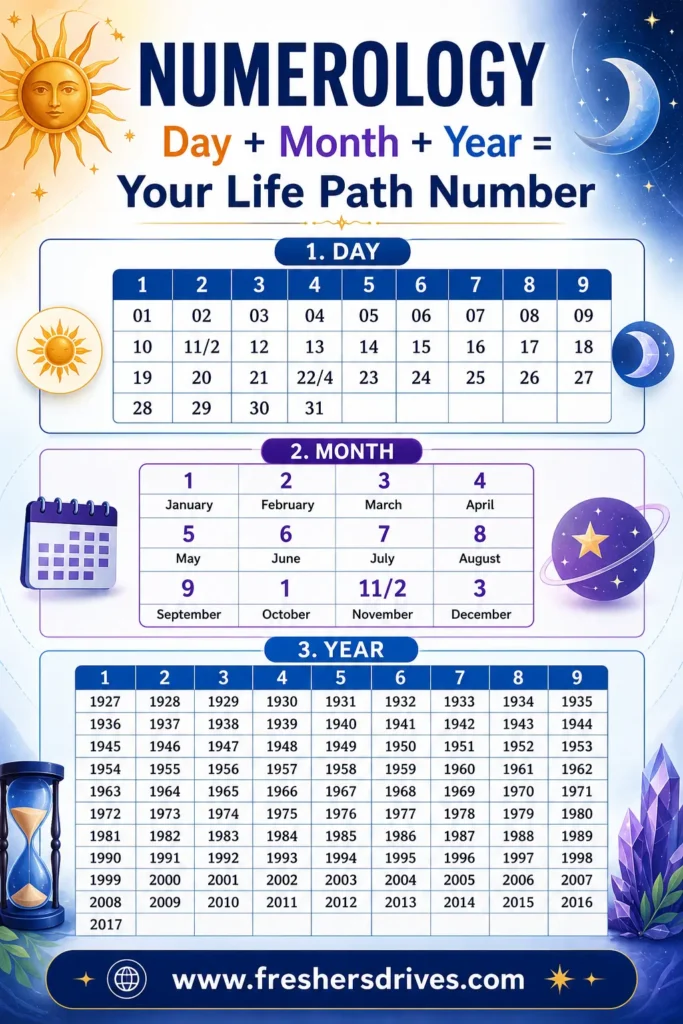
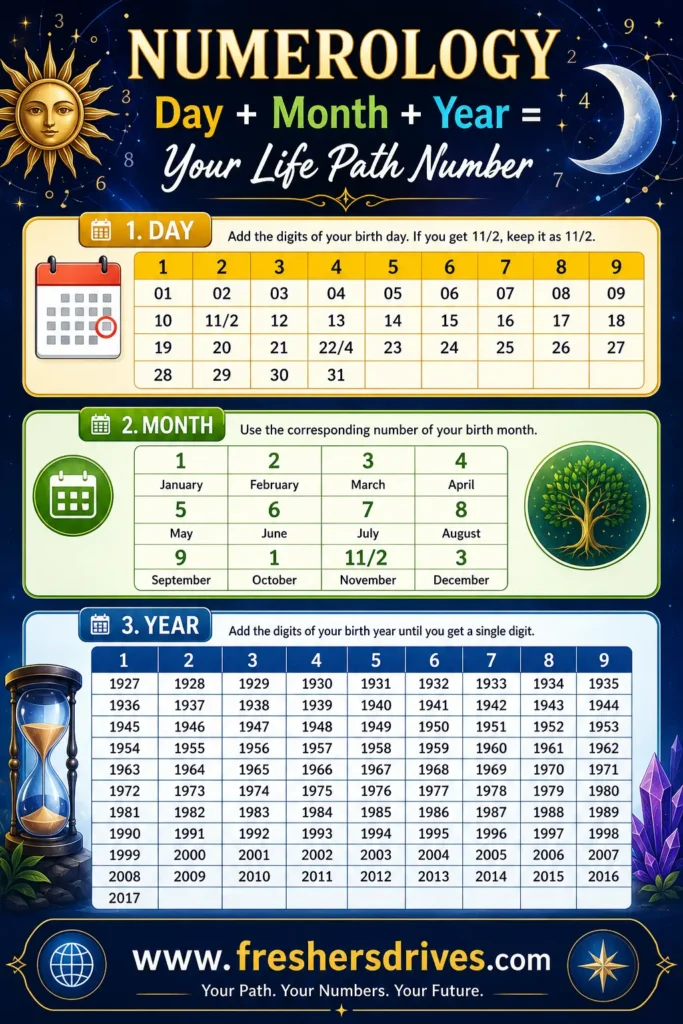
The appeal is speed and accuracy. A calculator removes the risk of misplacing a digit or miscounting a repeated number, something that’s surprisingly easy to do when you’re doing it manually for the first time.
Calculating Your Grid by Hand
If you’d rather understand the mechanics before relying on a tool, here’s the general process:
Step 1: Write out your date of birth in numbers. For example, someone born on 5th January 1996 would write it as 05-01-1996.
Step 2: Drop any zeros. Zero isn’t part of the traditional Lo Shu Grid, so it gets removed from the sequence. Our example becomes: 5, 1, 1, 9, 9, 6.
Step 3: Add a driver number. The driver number (sometimes called the personality number) comes from reducing the day of birth to a single digit. In our example, the day is 05, which reduces to 5.
Step 4: Add a conductor number. The conductor number (or destiny number) comes from reducing the full date of birth to a single digit by adding all the digits together and reducing repeatedly until you’re left with one number.
Step 5: Plot every digit onto the fixed grid positions. Each number has a fixed home cell in the grid (1 in the bottom-middle, 2 in the top-right, and so on, following the original magic square layout). Any digit that appears more than once in your birth date and calculated numbers gets repeated in that same cell.
Once everything is placed, you’ll be able to see clearly which numbers from 1 to 9 are present in your chart, and which ones don’t appear at all.
What Each Number in the Grid Means
Every number in the Lo Shu Grid is associated with a different area of life. Here’s a simple breakdown:
- 1 – Career and Ambition: How driven you are toward your goals and professional path.
- 2 – Relationships and Emotional Balance: Your capacity for partnership, harmony, and sensitivity.
- 3 – Health and Learning: Physical wellbeing along with your appetite for education.
- 4 – Stability and Discipline: Structure, routine, and how grounded you tend to be.
- 5 – Communication and Adaptability: Your ability to express yourself and adjust to change.
- 6 – Family and Responsibility: Domestic life, duty, and how you care for others.
- 7 – Inner Wisdom and Spirituality: Reflection, intuition, and mental clarity.
- 8 – Confidence and Willpower: Inner strength, memory, and self-belief.
- 9 – Recognition and Humanitarianism: Reputation, compassion, and how you’re perceived by others.
Reading Present, Missing, and Repeated Numbers
Once your grid is generated, there are three things worth paying attention to:
Present numbers show up at least once and generally indicate an area where you have some natural strength or ease, even if it’s not fully developed.
Repeated numbers appear more than once, and the more a number repeats, the more that particular trait is amplified in your personality. A number appearing four or more times is often considered especially significant.
Missing numbers are the ones that don’t appear anywhere in your grid. These are generally read as areas that may take more conscious effort to develop, rather than something that comes naturally.
For instance, someone missing the number 7 might find it takes more deliberate effort to slow down, reflect, or connect with their intuition, since that particular energy isn’t naturally present in their chart.
The Planes of the Lo Shu Grid
Beyond individual numbers, the grid can also be read in lines, known as planes, where three connected numbers are looked at together.
Horizontal Planes
- Top row (4-9-2): Associated with mental and intellectual ability.
- Middle row (3-5-7): Associated with emotional depth and spiritual inclination.
- Bottom row (8-1-6): Associated with practical success and material achievement.
Vertical Planes
- Left column (4-3-8): Associated with thought processes and ideas.
- Middle column (9-5-1): Associated with willpower and determination.
- Right column (2-7-6): Associated with action and follow-through.
Diagonal Planes
- 4-5-6 diagonal: Sometimes referred to as a particularly favorable combination, associated with wealth and recognition, though it’s considered rare to have all three numbers present.
- 2-5-8 diagonal: Associated with material and financial gain, though often paired with some degree of struggle along the way.
Having a complete plane, where all three numbers in that line are present in your grid, is generally read as a stronger, more balanced expression of whatever that plane represents.
What to Do About Missing Numbers
A missing number isn’t treated as a permanent flaw in numerology; it’s usually approached as an area that benefits from conscious attention. Practitioners often suggest small lifestyle habits tied to each missing number:
- Missing 1: Practice expressing your thoughts more directly, whether through writing or conversation.
- Missing 2: Focus on building patience and emotional connection in close relationships.
- Missing 3: Pick up a creative hobby or return to learning something new.
- Missing 4: Build more structure and routine into daily life.
- Missing 5: Push yourself out of your comfort zone occasionally, even in small ways.
- Missing 6: Spend more intentional time with family and close friends.
- Missing 7: Set aside quiet time for reflection, meditation, or simply being alone with your thoughts.
- Missing 8: Work on financial confidence and long-term planning.
- Missing 9: Look for small ways to help or give back to others.
None of these are meant as strict rules, more as gentle nudges toward balance in areas the chart suggests might need it.
Mistakes People Make When Reading Their Grid
- Forgetting to remove zeros before plotting. This is the single most common calculation error and throws off the entire reading.
- Skipping the driver and conductor numbers. Some people only plot the raw birth date digits and forget these two additional numbers, leading to an incomplete grid.
- Reading a single missing number in isolation. Numerology readings are usually meant to be considered as a whole picture, not judged from just one number out of context.
- Treating the grid as a fixed prediction. It’s best approached as a reflective tool for self-awareness rather than a rigid forecast of what will happen.
- Mixing up fixed cell positions. Each number has a specific home cell in the traditional layout; placing digits randomly defeats the purpose of the grid.
A Few Tips Before You Get Started
- Double check your date of birth entry before calculating, since even a small typo changes the entire chart.
- Look at your grid as a whole rather than fixating on a single missing or repeated number.
- If you’re new to numerology, start by reading about the meaning of numbers that appear most frequently in your own chart before moving on to interpreting missing ones.
- Revisit your reading periodically rather than treating it as a one-time check, since your interpretation of it may shift as you understand more about the system.
Frequently Asked Questions
1. What is a Lo Shu Grid calculator used for?
It’s used to generate a personal numerology chart based on your date of birth, showing which numbers from 1 to 9 are present, repeated, or missing, along with their associated meanings.
2. Is the Lo Shu Grid based on astrology?
Not directly. It comes from Chinese numerology and Feng Shui tradition rather than astrology, though both fields are often grouped together under the broader umbrella of occult or metaphysical practices.
3. What does it mean if a number is missing from my grid?
A missing number typically suggests that the trait or life area associated with that number may need more conscious effort or development, rather than coming naturally.
4. Can two people have the exact same Lo Shu Grid?
Yes, since the grid is based on date of birth alone, people born on the same date will generally have an identical base grid.
5. Do repeated numbers always mean something positive?
Not necessarily. A number that repeats many times is read as an amplified trait, which can express itself as a strength, but overly amplified traits are sometimes seen as needing more balance too.
6. Is it possible to have no missing numbers at all?
It’s rare but possible, depending on how the digits in a person’s birth date and calculated numbers happen to align across the nine grid positions.
7. How accurate is a Lo Shu Grid reading?
Like other numerology systems, it’s not something with scientific backing. It’s generally used as a tool for self-reflection and personal insight rather than a verified predictive method.
8. Can the Lo Shu Grid be used for anything besides personality analysis?
Yes, some practitioners extend it to relationship compatibility, career direction, or even evaluating phone numbers, though these applications build on the same basic present/missing number logic.
9. What’s the difference between the driver number and the conductor number?
The driver number comes from your day of birth alone, while the conductor number comes from reducing your entire date of birth to a single digit, and both are plotted into the grid alongside your raw birth date digits.
10. Do I need any numerology background to understand my results?
No. Most calculators explain your present and missing numbers in plain language, so you can get a basic understanding without prior knowledge of numerology.
Final Thoughts
The Lo Shu Grid is one of those tools that looks simple on the surface, just nine numbers in a box, but carries a surprising amount of depth once you start reading into what’s present, missing, or repeated in your own chart. Whether you’re approaching it out of curiosity or genuine interest in numerology, understanding the mechanics behind the grid makes the results a lot more meaningful than just glancing at a few numbers.
If you’d like to generate your own chart, plug in your date of birth into a Lo Shu Grid calculator and use this guide to make sense of what comes back.