
If you’re sending a parcel and searching for how to write address on DTDC courier, you’re not alone — this is one of the most common questions first-time courier senders have, and getting it wrong can lead to delivery delays, misrouted parcels, or even lost shipments.
DTDC, like most courier services in India, relies heavily on the accuracy and clarity of the address written on the package to ensure smooth delivery. Unlike postal services that sometimes allow more informal address formats, courier companies process thousands of parcels daily through automated sorting hubs, which means a clearly written, properly formatted address genuinely speeds up delivery and reduces errors.
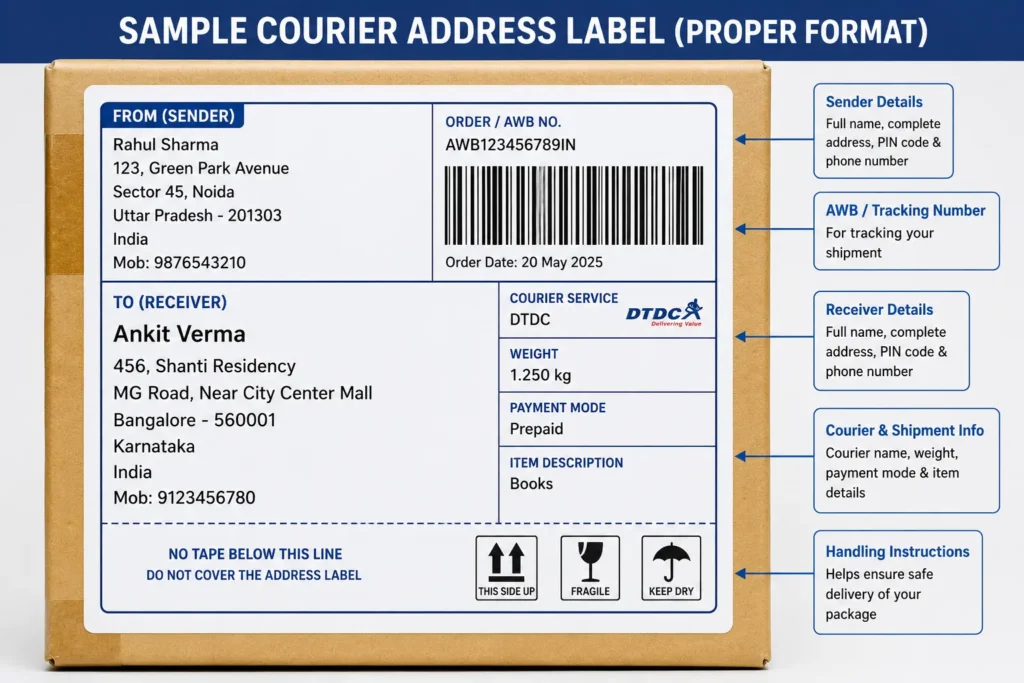
In this guide, we’ll walk through exactly how to write both the sender’s and recipient’s address, the correct format to follow, common mistakes people make, and practical tips to make sure your parcel reaches its destination without unnecessary delays.
How to Write Address on DTDC Courier
Why Address Format Matters for Courier Delivery
Courier companies like DTDC use a hub-and-spoke delivery model, where parcels are sorted at regional hubs before being routed to local delivery branches and finally to the recipient’s doorstep. At each of these stages, staff and automated systems rely on the address written on the package (along with any attached shipping label) to route it correctly.
A poorly written or incomplete address can cause a parcel to be:
- Misrouted to the wrong regional hub
- Delayed at a sorting facility while staff attempt to verify the address
- Returned to the sender if the address is deemed undeliverable
- Delivered to the wrong recipient in cases of duplicate or similar addresses in the same area
Taking a few extra minutes to write the address clearly and completely can save days of potential delay.
What Information You Need Before Writing the Address
Before you start writing on the parcel, make sure you have the following details ready for both sender and recipient:
- Full name of the recipient (and sender)
- Complete address, including house/flat number, street name, and locality
- Landmark (optional but highly recommended, especially for less common addresses)
- City and district
- State
- PIN code (extremely important for accurate sorting)
- Contact phone number for both sender and recipient
Missing even one of these details, particularly the PIN code or phone number, can cause delivery issues or delays.
Correct Format for Writing the Recipient’s Address
The recipient’s address should always be written clearly on the front (top) side of the parcel, since this is the primary address the courier will deliver to. Here’s the standard format to follow:
To,
[Recipient's Full Name]
[House/Flat No., Building Name]
[Street Name/Road]
[Locality/Area]
[Landmark, if any]
[City] - [PIN Code]
[State]
Phone: [Recipient's Contact Number]
Write each line clearly, ideally in capital letters or clear print handwriting, to avoid any misreading during sorting and delivery.
Correct Format for Writing the Sender’s Address
The sender’s address (your own address, if you’re sending the parcel) should be written on the same side as the recipient’s address, but in a slightly smaller size or in a clearly marked “From” section, usually in one of the top corners of the parcel. The format is similar:
From,
[Sender's Full Name]
[House/Flat No., Building Name]
[Street Name/Road]
[Locality/Area]
[City] - [PIN Code]
[State]
Phone: [Sender's Contact Number]
The sender’s address is particularly important in case the parcel needs to be returned due to a delivery failure, so make sure this is just as accurate and complete as the recipient’s address.
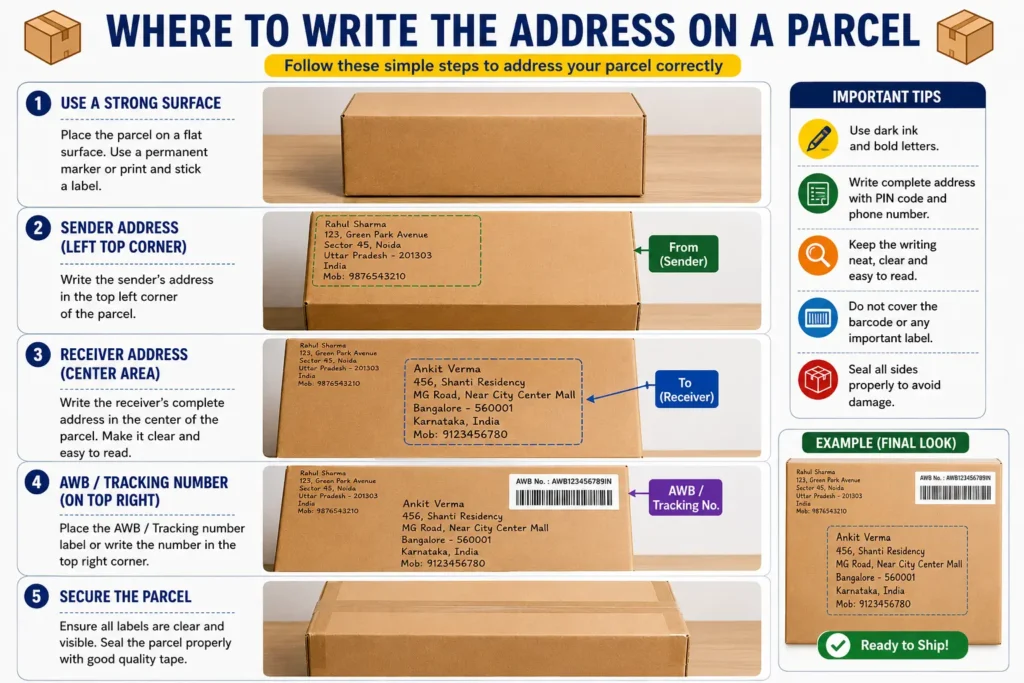
Where to Write the Address on the Parcel
For most DTDC courier bookings, especially through a franchise or booking center, you’ll typically fill out a consignment note (courier receipt/waybill) provided by DTDC staff, where you write both sender and recipient details in the designated fields. In addition to this:
- If DTDC provides a printed shipping label (common for prepaid or online bookings), affix it clearly and securely on the top surface of the parcel, making sure it isn’t wrinkled, folded, or covering any barcode/QR code needed for scanning.
- If you’re writing the address directly on the parcel (in cases where no label is provided), use a permanent marker and write on a flat, visible surface — ideally the largest flat side of the box, avoiding edges, seams, or tape lines where the writing could get damaged or obscured.
- Avoid writing the address near existing barcodes, stickers, or courier company markings, since this can confuse the automated scanning process at sorting hubs.
Sample Address Format for DTDC Courier
Here’s a complete sample to give you a clear visual reference:
To,
Rajesh Kumar
Flat No. 302, Shreeji Residency
MG Road, Near City Hospital
Bengaluru - 560001
Karnataka
Phone: 98XXXXXXXX

From,
Anitha Reddy
No. 45, Lakshmi Nagar
2nd Cross Street
Chennai - 600020
Tamil Nadu
Phone: 97XXXXXXXX
Notice how each line is broken down clearly — name, address lines, city with PIN code, state, and phone number — rather than cramming everything into a single continuous line. This structured format is much easier for delivery staff to read quickly and accurately.
Writing Address for Different Types of Parcels
Documents
For sending documents through DTDC, the same format applies, but make sure the envelope or document pouch has enough space to write both addresses clearly without folding over important text.
Small Packages/Boxes
Write the address on the largest flat surface of the box. If the box is small, consider attaching a printed label instead of hand-writing directly on the packaging material, especially if the surface is uneven or textured.
Bulk or Business Shipments
For businesses sending multiple parcels regularly, using pre-printed shipping labels (often generated through DTDC’s online booking or business account system) is far more reliable than handwritten addresses, since it reduces human error and speeds up processing at scale.
Common Mistakes to Avoid
- Missing the PIN code. This is one of the most critical pieces of information for sorting — without it, delivery can be significantly delayed even if the rest of the address is correct.
- Writing an incomplete or vague address. Simply writing a locality name without a house number or street name makes it difficult for delivery staff to locate the exact address.
- Illegible handwriting. If delivery staff can’t read the address clearly, this often leads to failed delivery attempts or return-to-sender situations.
- Not including a contact number. Many delivery issues are resolved quickly with a phone call to the recipient — skipping this detail removes that safety net.
- Covering the barcode or shipping label with additional writing or tape. This can prevent proper scanning at sorting hubs, causing delays.
- Forgetting to include a landmark for less common addresses. In areas without clearly numbered streets, a landmark can make the difference between a smooth delivery and a failed attempt.
- Writing sender and recipient addresses in a way that’s easy to confuse. Make sure “To” and “From” sections are clearly labeled and visually distinct.
Expert Tips for Faster, Error-Free Delivery
- Double-check the PIN code against an official source. If you’re unsure of the exact PIN code for an address, verify it through the India Post PIN code lookup tool before writing it on the parcel.
- Use block/capital letters when handwriting addresses. This significantly reduces the chance of misreading, especially for staff unfamiliar with cursive or stylized handwriting.
- Always include a working phone number for both sender and recipient. This allows delivery staff to coordinate directly in case of any address confusion or delivery scheduling issues.
- If booking online, always cross-verify the address in the system before confirming. Auto-filled addresses can sometimes carry over errors from previous entries.
- Keep a copy of the consignment note/tracking number until the parcel is confirmed delivered. This makes it much easier to follow up with DTDC customer support if any delivery issue arises.
Frequently Asked Questions
1. What is the correct format to write an address on a DTDC courier? The correct format includes the recipient’s name, house/flat number, street name, locality, landmark (if any), city with PIN code, state, and contact phone number, each written on a separate line for clarity.
2. Do I need to write the sender’s address as well? Yes. The sender’s address should always be included, typically in a “From” section, since it’s used for returns in case the parcel cannot be delivered.
3. Where exactly should I write the address on the parcel? On the largest flat surface of the box, or in the designated fields on DTDC’s consignment note/waybill if you’re booking through a franchise or courier office.
4. Is the PIN code really necessary for courier delivery? Yes, the PIN code is one of the most important details for accurate sorting and routing at courier hubs, and missing it often causes delivery delays.
5. Can I write the address by hand, or do I need a printed label? Both are acceptable for most DTDC shipments, but a printed label is generally more reliable for legibility, especially for bulk or business shipments.
6. What should I do if I don’t know the exact PIN code of the recipient’s address? You can look up the correct PIN code using the official India Post PIN code lookup tool before writing the address on the parcel.
7. Should I include a landmark in the address? Yes, especially for areas without clearly numbered streets or in less commonly known localities, as it helps delivery staff locate the address more easily.
8. What happens if the address I wrote is incomplete or incorrect? The parcel may be delayed at a sorting hub, misrouted, or returned to the sender if delivery staff are unable to verify or locate the correct address.
9. Can I use a shipping label instead of handwriting the address? Yes, if you’ve booked through DTDC’s online system or a franchise that provides a printed shipping label, affixing this clearly is often more reliable than handwriting.
10. Is it necessary to include a phone number for both sender and recipient? Yes, phone numbers allow delivery staff to quickly resolve any confusion or coordinate delivery timing, and their absence can lead to unnecessary delays.
Conclusion
Writing the address correctly on a DTDC courier parcel isn’t complicated, but it does require attention to detail. Including the recipient’s and sender’s complete address, a valid PIN code, a landmark where relevant, and a working phone number for both parties will significantly reduce the chances of delays, misrouting, or failed delivery attempts.
Take the extra few minutes to double-check every detail before handing over your parcel — it’s a small step that can save days of potential delivery hassle.
Read More:
How to Fix Mouse Double Clicking (Easy Fixes)